⚠️ Incident Debrief #001
Viking Sky — Engine Blackout in
Extreme Norwegian Seas
Location
Hustadvika, Norway
Incident Type
Complete Blackout
Evacuated
479 by helicopter
Root Cause
Lube oil starvation
Source
AIBN Report 2020/07
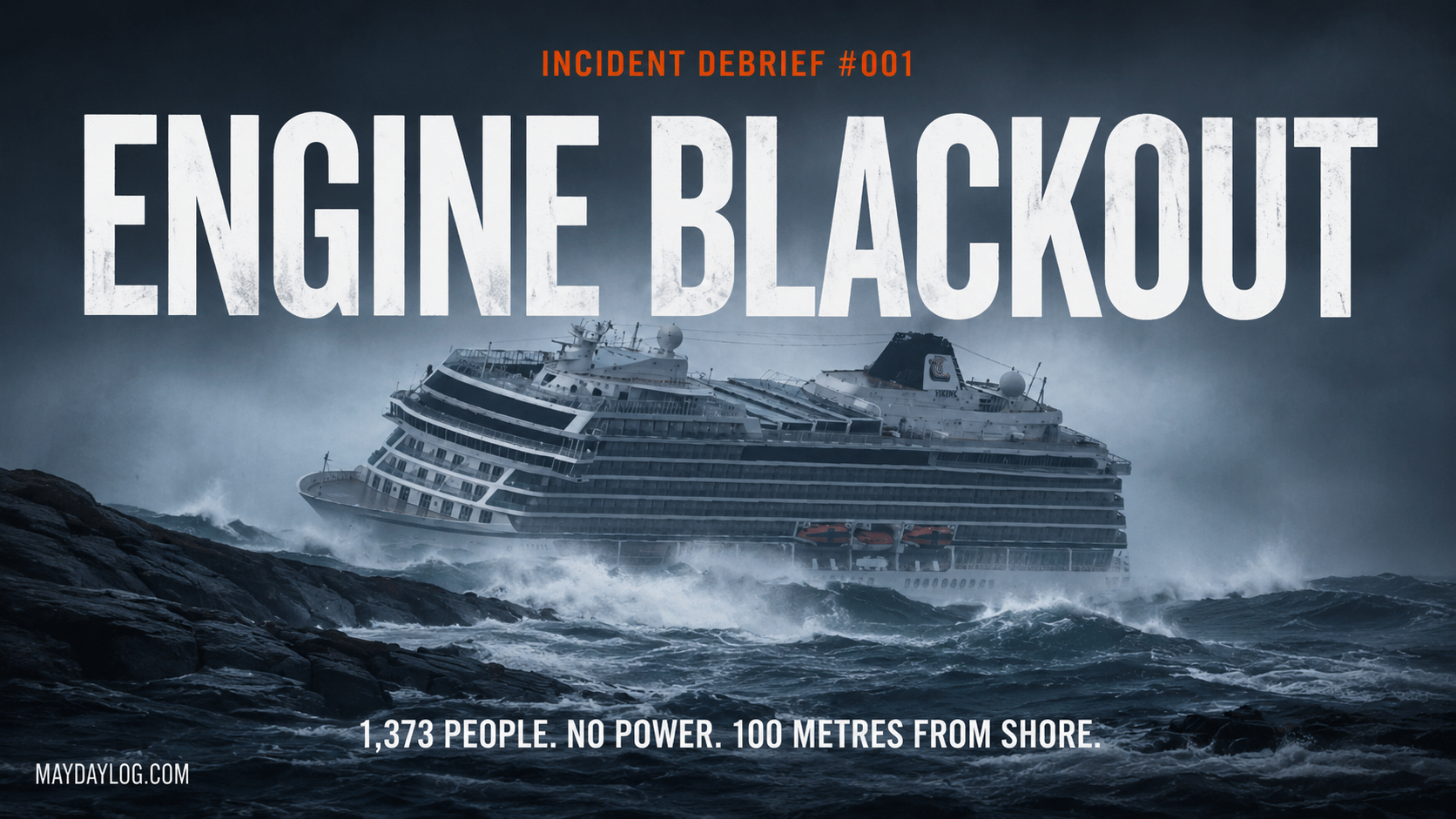
MS Viking Sky drifting towards the rocky Hustadvika coastline after losing all propulsion — 23 March 2019. Source: Norwegian rescue services / NTB Scanpix.
19
Minutes from first alarm to complete blackout
8–9m
Wave height during the incident
28%
Lube oil level — spec required 68–75%
~100m
Distance from rocky shore at closest point
479
Passengers airlifted over 24 hours
What Happened
A Ship, A Storm, and a Silent Failure Nobody Caught
On the afternoon of 23 March 2019, the cruise ship Viking Sky was crossing Hustadvika — one of Norway's most notoriously dangerous stretches of coastline. The Admiralty Sailing Directions describe it plainly: "completely exposed to weather, extensive shoals lie offshore." The ship was sailing in strong gale to storm force winds — Beaufort 9 to 10 — with wave heights of 8 to 9 metres.
On board were 915 passengers and 458 crew — 1,373 people total. Most passengers were American and British citizens. The ship had cancelled a port call at Bodø due to deteriorating weather and was heading directly for Stavanger.
What followed unfolded in under 20 minutes — and brought a modern cruise ship within approximately 100 metres of a rocky shoreline with no propulsion and no power.
Between 05:00 and 09:04 that morning, 18 lubricating oil alarms had already been registered and accepted by the engine room. Each cleared within seconds. Nobody connected the dots. Six hours later, those alarms told the story of what was about to happen.
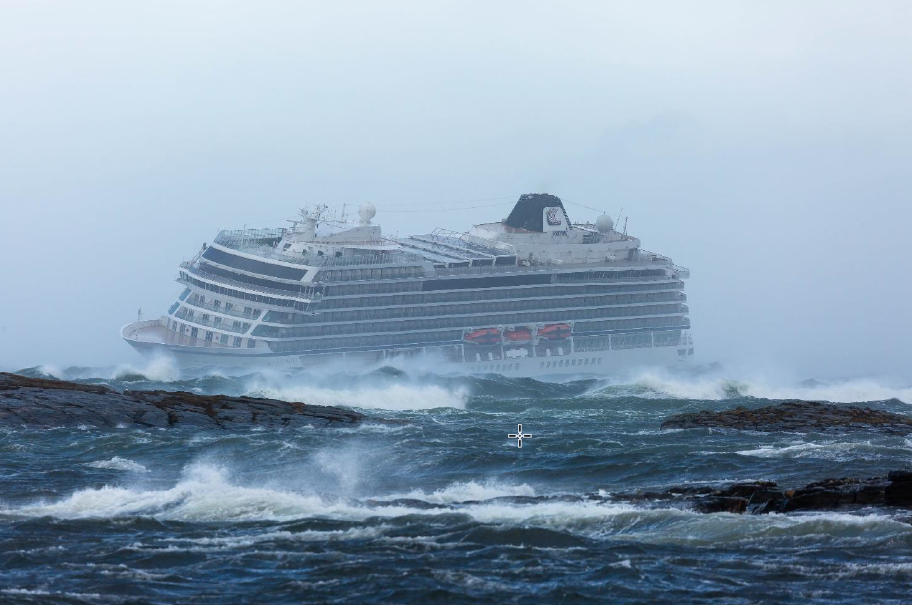
Hustadvika — described by Admiralty Sailing Directions as "notoriously dangerous." Extensive shoals, completely exposed to weather, breaking surf reported throughout. Source: Norwegian Coastal Administration.
05:00WARNINGFirst lube oil low level alarm — clears within secondsDG (multiple)
09:04WARNING18th lube oil alarm accepted — pattern not investigatedDG (multiple)
13:37CRITICALDG4 shedding load — low lubricating oil pressure alarm firesDG4
13:39CRITICALLow-low lubricating oil sump level alarm triggeredDG1
13:45CRITICALDG4 auto-shutdown — low lube oil pressure confirmedDG4 ❌
13:45CRITICALDG2 shuts down 8 seconds after DG4DG2 ❌
13:58BLACKOUTDG2 and DG1 both shutdown — COMPLETE BLACKOUT — all propulsion lostALL ❌
Timeline
Minute by Minute — Bridge and Engine Room
13:37
First critical alarm triggers
DG4 registers low lubricating oil pressure and begins shedding load. Ship is in Beaufort 9–10 — pitching and rolling severely.
Warning Phase13:45
DG4 shuts down — DG2 follows 8 seconds later
Two of four diesel generators automatically shut down due to low lube oil pressure. DG3 already offline for turbocharger repairs — only DG1 remains.
Engines Failing13:58
COMPLETE BLACKOUT — All propulsion lost
DG2 and DG1 both shut down. Viking Sky has zero propulsion. Ship drifts astern towards rocky shoreline at 6–7 knots.
Total Blackout14:00
Master broadcasts MAYDAY
Southern Norway JRCC launches major rescue operation. Helicopters scrambled. 1,373 people on board drifting towards shoals.
MAYDAY Declared14:06
Both anchors deployed
Starboard anchor at 14:06, port at 14:20. Anchors do not hold in storm conditions. Ship continues drifting.
Anchors Deployed14:13
General Alarm — passengers muster
Viking Sky passes within approximately 100 metres of 10-metre shoals — the closest she comes to grounding.
Closest to Grounding14:22
DG2 restarted — partial power restored
Engineers transfer 10.8 m³ of lube oil to sump tanks. DG2 restarted in manual load-sharing mode. Power restored — fragile and manually managed.
Power Restored14:29
Propulsion motors restarted
Port motor at 14:29, starboard five minutes later. Viking Sky has slow-speed propulsion. No longer drifting towards shore.
Propulsion Restored15:05
First helicopter — evacuation begins
Crew maneuvers vessel into wind for helicopter operations. Lifeboat evacuation ruled too dangerous. Airlift begins one passenger at a time.
Evacuation Begins24 Mar 09:15
Master declares vessel safe — 479 evacuated
Weather improves overnight. Tugs secured fore and aft. Master declares vessel out of danger. Viking Sky docks in Molde at 16:25.
Incident Resolved
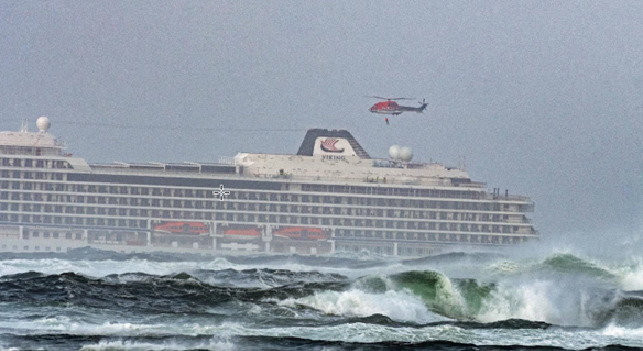
Norwegian rescue helicopters airlifted 479 passengers one by one from Viking Sky's deck — a 24-hour operation in deteriorating sea conditions. Photo: Norwegian Air Force / Joint Rescue Coordination Centre.
Technical Analysis
The Engine Room — What Was Running and What Failed
Viking Sky had a diesel-electric propulsion system. Four diesel generators produced electricity which powered electric motors driving the azipod propellers. The ship had two separate engine rooms — forward and aft — each containing one large and one small generator.
Viking Sky — Diesel Generator Status at Time of Incident
Aft Engine Room
DG3
6,720 kW
Offline (repairs)
DG3 already offline — MAN technician onboard for turbocharger repairs before the incident
The Failure Chain — Oil Starvation in Heavy Seas
Sump at 28–40%
(spec: 68–75%)
→
Heavy rolling
8–9m waves
→
Oil sloshes
from intakes
→
Low pressure
alarm fires
→
Auto-shutdown
all 3 DGs
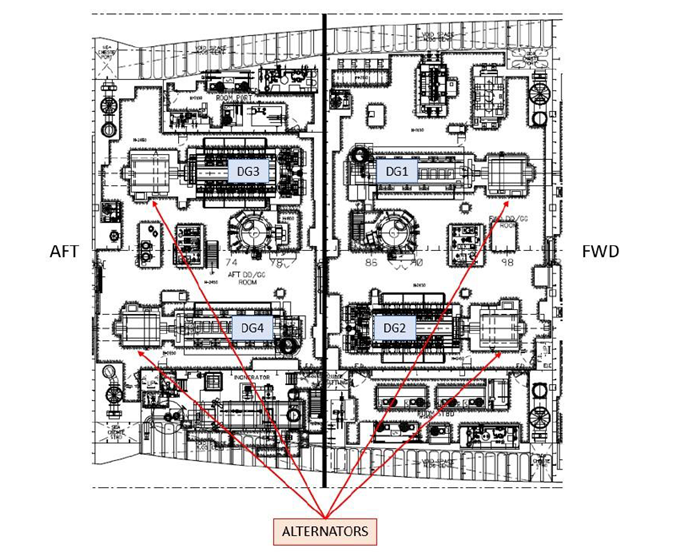
Diesel generator similar to MAN units fitted on Viking Sky. Each DG produced 5,040–6,720 kW of electrical power.
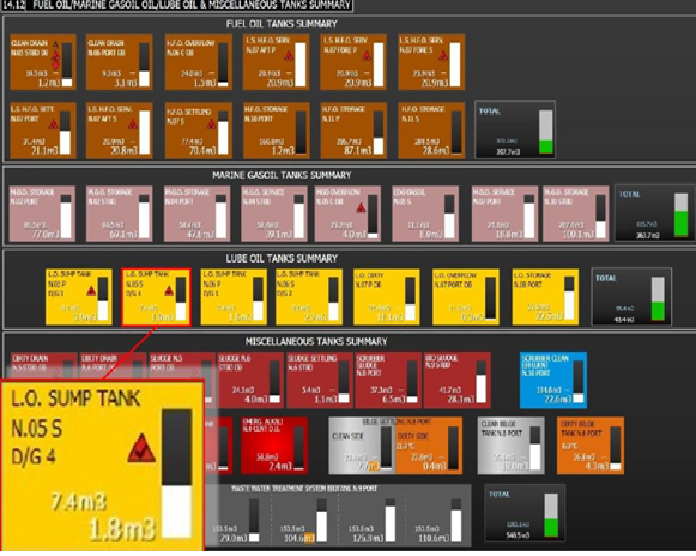
Lubricating oil sump tank — Viking Sky's were maintained at 28–40% capacity instead of the specified 68–75%.
Root Cause Analysis
It Wasn't Just Low Oil — It Was a System That Allowed It
The AIBN investigation found the diesel generators shut down due to loss of lubricating oil suction caused by low sump tank levels combined with pitching and rolling in storm conditions. But the root cause goes deeper than that single finding.
01
Sump levels critically below specification
Lube oil sump tanks maintained at 28–40% capacity. Specification required 68–75%. Not topped up before sailing into forecast storm conditions. Within alarm limits — but not safe for severe weather.
02
18 alarms ignored over 4 hours
Between 05:00 and 09:04, 18 lube oil alarms were registered, accepted, and forgotten. Each cleared within seconds. The pattern was never investigated. These were the warning signs hiding in the alarm log.
03
One generator already offline
DG3 was already inoperative for turbocharger repairs. The ship entered dangerous waters with reduced redundancy and critically low oil levels simultaneously.
04
Cascading failure — same vulnerability
All three operational generators shared the same failure mode. When the sea state caused oil to slosh from intakes, they failed in sequence. True redundancy requires different failure modes.
05
No heavy weather lube oil procedure
No specific procedure required checking and topping up lube oil before entering forecast severe weather. The Norwegian Maritime Authority issued a safety notice requiring exactly this within days of the incident.
The key engineering insight: The safety shutdown systems worked perfectly — they detected low oil pressure and shut the engines down exactly as designed. The problem was the condition that made shutdown inevitable. The systems protected the engines. Nothing protected the ship.
Lessons Learned
5 Lessons Every Marine Engineer Must Take From Viking Sky
These are not theoretical. These are direct takeaways from the AIBN investigation — applicable to every watchkeeping engineer on every vessel.
1
Minimum level is not a safe level in bad weather
The lube oil levels were within alarm limits — but far below what was safe in storm conditions. Before any heavy weather passage, top up all consumables to maximum. The sea does not care what the manual says.
→ Apply before every heavy weather passage
2
Alarm patterns are data — not noise to accept
18 alarms over 4 hours, each clearing within seconds, each accepted and forgotten. A pattern of transient alarms is a system trying to communicate. Ask why the alarm appeared — not just whether it has cleared.
→ Investigate repeated transient alarms immediately
3
True redundancy requires different failure modes
All four generators shared the same vulnerability. When a single sea state can take down all backup systems simultaneously, redundancy is an illusion. Review your vessel's critical systems for shared failure modes.
→ Challenge your vessel's redundancy assumptions
4
Bridge decisions have engine room consequences
The decision to cross Hustadvika in Beaufort 9–10 was made on the bridge. The engine room lived with the consequences. Engineers should understand passage plans and flag engineering risks before entering dangerous waters.
→ Attend passage planning when heavy weather is forecast
5
Know your blackout recovery procedure from memory
The Viking Sky engineers recovered propulsion within 24 minutes of total blackout under extreme pressure. They transferred 10.8 m³ of oil and manually managed load sharing. This was only possible because they knew the procedures cold. Drills save lives.
→ Know your blackout recovery procedure before it happens
📄
Official Investigation Source
Accident Investigation Board Norway (AIBN) — Report Marine 2020/07
Interim Report: 12 November 2019 · Final Report: May 2024
Co-investigated with MAIB (UK), NTSB (USA), and ATSB (Australia)
Read the full AIBN report → aibn.no